via ibnlive.in.com
So, are you psyched for the new Harry Potter movie? Like you, your kids, and approximately 99% of humanity, I confess: I too am captivated by the thought of a magical world where diligently memorized incantations can grant thunderous powers beyond the reach of mortals. "Accio, job growth!"
If only it were that easy. In our messy muggle world, there are no magic formulas. So, while many of you have been asking me for a roadmap to prosperity — and I've tried to offer a blueprint of a better kind of business — it might be that, despite what late-night infomercials and endless banner ads suggest, there's probably no framework you can pick up off the shelf, pay a few bucks for, do a little dance around, and (voila!) prosper. The plain fact is that great achievement, deep fulfillment, lasting relationships, or any other aspects of an unquenchably, relentlessly well lived life aren't formulaically executable or neatly quantifiable. First and foremost, they're searingly, and deeply personally, meaningful. The inconvenient truth is: you'll probably have to not just blaze your own trail — you'll also probably have to plot your own map for own journey.
So while I can't offer a roadmap, I can try and give you a pen and protractor instead to help you begin to create your own:
Put what, why, and who you love ahead of what, why, and who you don't, and your roadmap will begin to write itself.Now, my little principle might cause those with hand-made suits and beancounterly tendencies to leap out of their chairs and hit me with the tarantallegra jinx. But even the cynics might be willing to admit: given a mysteriously non-recovering "recovery" for a global economy perpetually poised on the brink of perma-crisis, the status quo's out of ideas, out of options, and running out of time.
In an economy dedicated to the pursuit of more, bigger, faster, cheaper, nastier, the greatest hidden cost and unintended consequence is that something vital, enduring, resonant, and animating has gone missing from our lives — and it might just be the biggest thing: meaning in what we do, and why we're here.
More, bigger, faster, cheaper, nastier has built an economy that might just be in furious pursuit of mediocrity. Five hundred channels and nothing on, corporations whose behavior plunges past merely unethical, or criminal, to sociopathic, big box stores larger than an airplane hangars, billions of dreary, me-too, not-so-great "goods" that fail to inspire, not enough McJobs to go around, financial markets that are more deft at blowing up scarce resources than at allocating them.
So what went wrong with our path to prosperity? I'd suggest: our economy might be in pursuit of mediocrity because too many of us put what, why, and who makes us want to go into a fetal crouch, plug our ears, and bang our foreheads against our knees above, beyond, and before what, why, and who we love.
There's no magic formula for a life well lived, but my humble suggestion is that the above is probably the polar opposite: a surefire recipe for a life poorly lived, for intellectual, relational, social, ethical, and creative stagnation. Hence, what's stagnating not just our economy — but our human potential. Too many of us (and some have argued, the best and brightest among us) are trained from birth to be — and rewarded with each bonus to remain — what economists call "rent-seekers," experts at squabbling over (and winning) the last stale morsels of yesterday's fading industrial age harvests, the mere mechanics and advocates of wealth extraction, instead of value creators, the architects and master builders, dreamers and doers, theorists and practitioners of the art of great human accomplishment.
Hence, I'd suggest: my tiny principle might not just a disposable epigram, but a diagnosis for dysfunction — and a challenge to all of you. The pursuit of more, bigger, faster, cheaper, nastier too often seems to demand putting what, why, and who we love at the end of the list, the underworld of the inbox, the bottom of the heap. That's a recipe for stagnation, whether for people, communities, cities, countries, or the globe. But the converse might just hold, too: if nations and corporations want to punch past the glass ceiling of mere opulence, to what I call eudaimonic prosperity — lives that are meaningfully well lived — well, then people might just have to begin by making if not radically, then at least marginally more meaningful choices themselves.
Here's what my little principle doesn't mean: immediate, lowest-common-denominator self-gratification. That, for example, since you "love" Jersey Shore, you should spend all day, every day GTLing harder than the last. Sorry, lotus eaters. Instead, what it suggests is that if you "love" GTL that much, then, well, your roadmap might be clear. Whatever the method to your madness, whether inventing a better tanning bed, perfecting a better workout, or devising less water-intensive laundry, the authenticity principle says: don't just mutely "consume" it — live it. Better it, reimagine it, blow the doors off it, and don't stop until you're within shouting distance of the point that it matters to the future of humanity.
The roadmap you need to follow is deeply, resonantly, profoundly, and irrevocably your own — the one that calls to you in every dreary meeting, every missed birthday, and every misplaced-but-not-quite-forgotten dream. It's the one that leads you to your better self. It says: "Follow my lead. Let's go somewhere that matters — not just somewhere that glitters."

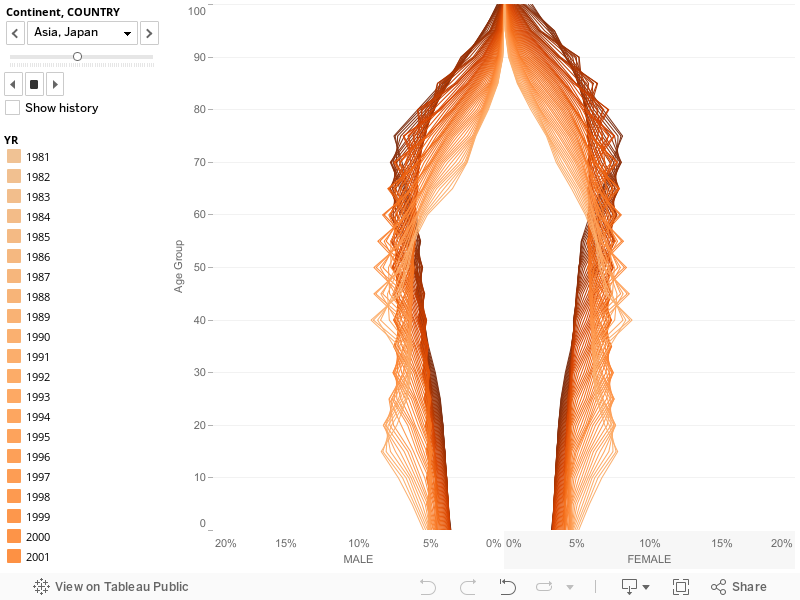
Well, here is my first chart in Tableau, finally! After publishing my experiments with population pyramids (using Excel), I thought I could try Tableau Public with the same dataset from the US Census Bureau. Here is the result. I never really played before with Tableau Public and it took my less than an hour to upload the data and make this chart, without reading a manual or watching a tutorial (changing line colors was the hard part). It says a lot about its usability.
Population Pyramids 1981-2050
Sheet 1 – Asia, Japan
So, what do you think? There’s a lot to learn and your comments are much appreciated.
You may also be interested in:
If you're like most people I work with in companies, the demands come at you from every angle, all day long, and you have to make difficult decisions without much time to think about them. What enduring principles can you rely on to make choices that reflect openness, integrity and authenticity?
Here are ten that work for me:
1. Always challenge certainty, especially your own. When you think you're undeniably right, ask yourself "What might I be missing here?" If we could truly figure it all out, what else would there be left to do?
2. Excellence is an unrelenting struggle, but it's also the surest route to enduring satisfaction. Amy Chua, the over-the-top "Tiger Mother," was right that there's no shortcut to excellence. Getting there requires practicing deliberately, delaying gratification, and forever challenging your current comfort zone.
3. Emotions are contagious, so it pays to know what you're feeling. Think of the best boss you ever had. How did he or she make you feel? That's the way you want to make others feel.
4. When in doubt, ask yourself, "How would I behave here at my best?" We know instinctively what it means to do the right thing, even when we're inclined to do the opposite. If you find it impossible, in a challenging moment, to envision how you'd behave at your best, try imagining how someone you admire would respond.
5. If you do what you love, the money may or may not follow, but you'll love what you do. It's magical thinking to assume you'll be rewarded with riches for following your heart. What it will give you is a richer life. If material riches don't follow, and you decide they're important, there's always time for Plan B.
6. You need less than you think you do. All your life, you've been led to believe that more is better, and that whatever you have isn't enough. It's a prescription for disappointment. Instead ask yourself this: How much of what you already have truly adds value in your life? What could you do without?
7. Accept yourself exactly as you are but never stop trying to learn and grow. One without the other just doesn't cut it. The first, by itself, leads to complacency, the second to self-flagellation. The paradoxical trick is to embrace these opposites, using self-acceptance as an antidote to fear and as a cushion in the face of setbacks.
8. Meaning isn't something you discover, it's something you create, one step at a time. Meaning is derived from finding a way to express your unique skills and passion in the service of something larger than yourself. Figuring out how best to contribute is a lifelong challenge, reborn every day.
9. You can't change what you don't notice and not noticing won't make it go away. Each of us has an infinite capacity for self-deception. To avoid pain, we rationalize, minimize, deny, and go numb. The antidote is the willingness to look at yourself with unsparing honesty, and to hold yourself accountable to the person you want to be.
10. When in doubt, take responsibility. It's called being a true adult.