Try a Day Without ICT4D - I Dare You! | ICTWorks

no-ict4d-day.jpg

TOMS Shoes has come under much criticism for its "Day without shoes" event to promote its shoe marketing approach. While I don't support shoe donations, I do like the idea of a day without something to show it’s a daily need.

So what about "A Day Without ICT4D"?

I think we should organize a "Day Without ICT4D" where every development program, in every discipline from healthcare to education to economic development to disaster relief has to turn off all the electronics they use, shut down all their web sites and go completely offline for the day. I know a number of people (our spouses and children) would celebrate this occasion with real human-to-human conversation and discourse.

It would serve a great purpose - education

It would only take one day without email, one day without web services or phone calls to put a real shock to international development. The naysayers who doubt the need for ICT, the old-school development folks who think we need capacity building, not gadgets, and those that seek randomized control trials of everything before they'll invest in anything will all scream in unison for their telecommunications support structure.

They would then realize that ICT4D is a real need. It is a real crosscutting facilitator of all the interventions and approaches in every development activity. It's not a fad. Its not an app. ICT4D is required fro modern international development - at every level.

And after a Day Without ICT4D, we would get the funding and respect we deserve.


A Guide to the Instagram Filters You'll Soon Be Seeing on Facebook - Megan Garber - Technology - The Atlantic

Share

Share

Share on facebook Share on linkedin Share on twitter
« Previous Technology | Next Technology » Email

Email

Print

Print

A Guide to the Instagram Filters You'll Soon Be Seeing on Facebook

By Megan Garber

Apr 10 2012, 7:34 AM ET

Your coffee, filtered on Instagram [Image: Jessica Zollman/Creative Commons]

Now that it's been acquired by Facebook, Instagram is no longer just a social network; it's part of the social network. Which means, among other things, that Facebook is about to become prettier/cheekier/even more full of unmitigated '70s flare.

It also means that users of Facebook will soon have many more options when it comes to the ways they represent themselves, visually, through its platform. Is that photo of you and your dog Walden-worthy, or is it more Brannan-y? Was your birthday party the serious stuff of black-and-white Inkwell, or does it call for the ironic saturation of a Nashville or a Toaster? 

To help you navigate these unfiltered waters, here's a guide to some of the Instagram products you may soon be seeing on Facebook. 

Normal
Effect: Also known as "no filter" (or, more popularly, #nofilter), this is Instagram at its purest: filter-free
Use for: Anything, really

X-Pro II
Effect: Warm, saturated tones with an emphasis on aquas and greens
Use for: That photo of you on the beach with your new boyfriend, meant to make your old boyfriend jealous

Earlybird
Effect: Faded, blurred colors, with an emphasis on yellow and beige
Use for: That photo of you at brunch with your new boyfriend, meant to make your old boyfriend jealous

Lomo-fi
Effect: Dreamy, ever-so-slightly blurry, with saturated yellows and greens
Use for: Food pictures -- those cookies you just baked, that steak you just grilled, etc.

Sutro
Effect: Sepia-like, with an emphasis on purples and browns
Use for: Arting up photos of otherwise mundane objects: cups of coffee, coffee stirrers, coffee stains on napkins, etc.

Toaster
Effect: High exposure, with corner vignetting
Use for: "Mad Men"-esque takes on your night out, your picnic with friends, your backyard BBQ, etc.
Fun Fact: This filter was named after Kevin Rose's dog.

Brannan
Effect: Low-key, with an emphasis on grays and greens
Use for: Pictures of your dog

Valencia
Effect: True-to-life contrast, with slightly gray and brown overtones
Use for: Pictures of Kevin Rose's dog 

Inkwell
Effect: Black-and-white, high-contrast
Use for: Giving any old picture a classically old-school effect, and/or disguising bad lighting in your #nofilter photo

Walden
Effect: Washed-out color with bluish overtones
Use for: Pictures of last weekend's pool party

Hefe
Effect: Fuzziness, with an emphasis on yellow and golden tones
Use for: Making last weekend's pool party look like it took place in Palm Springs, in 1960

Nashville
Effect: Sharp images with a magenta-meets-purple tint, framed by a distinctive film-strip-esque border
Use for: Photos that call for ironic nostalgia

1977
Effect: Gloria Gaynor-level '70s flair
Use for: Photos that call for in-your-face nostalgia (particularly useful now that Facebook is Timelined)

Lord Kelvin
Effect: Super-saturated, supremely retro photos with a distinctive scratchy border
Use for: Photos that call for actual nostalgia

More at The Atlantic

<div></div>

Join the Discussion

After you comment, click Post. If you’re not already logged in you will be asked to log in or register.

Please enable JavaScript to view the comments powered by Disqus. blog comments powered by Disqus

What’s in a Name? | The Intercom Blog

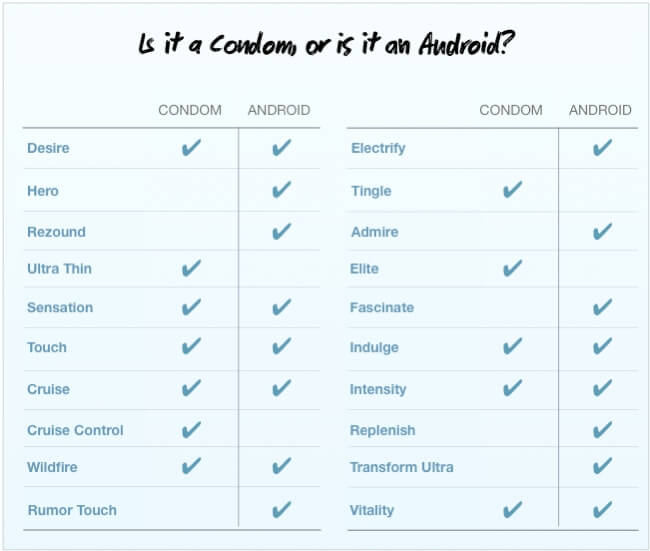
Naming a product is difficult. Branding legend Marty Neumeier says that good product names have 7 characteristics. They should be distinctive, short, appropriate, easy to spell and pronounce, likable, extendable, and protectable. Looking through this list of Android names, it’s clear that many marketing teams disagree with Marty.

Here’s a simple rule: if your product isn’t a condom then don’t name it like one. What am I talking about? Let’s take a look…

Which will run out first: the list of “sexy sounding product names”, or the list of meaningfully different ways to differentiate Android phones?

I know where my money lies.

EatingWell: 10 Bad Cooking Habits You Should Break

10 Bad Cooking Habits You Should Break
By Hilary Meyer, Associate Food Editor, EatingWell Magazine

Some habits can be tough to break. When it comes to cooking, you may have some bad habits that you’re not even aware of. Some may be keeping your meal just short of reaching perfection while others may actually be hazardous to your health. Below are 10 common bad cooking habits that you should break:

1. Heating Oil Until It Smokes—Most recipes start with heating oil in a pan. It usually takes a little time for the stove to warm up, so we pour the oil and then turn our backs on the pan to do something else while it heats. Before you know it, you see wisps of smoke, which means the pan is hot and ready for cooking, right? Wrong! Not only do many oils taste bad once they have been heated to or past their smoke point, but when oils are heated to their smoke point or reheated repeatedly, they start to break down, destroying the oil’s beneficial antioxidants and forming harmful compounds. However, an oil’s smoke point is really a temperature range (olive oil’s is between 365° and 420°F), not an absolute number, because many factors affect the chemical properties of oil. You can safely and healthfully cook with any oil by not ­heating it until it’s smoking—to get your oil hot enough to cook with, just heat it until it shimmers.

Don’t Miss: The 2 Best Oils for Cooking (and 2 to Skip)

2. Stirring Your Food Too Much—It’s tempting to stir your food constantly to prevent burning, but stirring too much can be a bad thing. It prevents browning—a flavor booster you get by letting your food sit on a hot surface—and it breaks food apart, making your meal mushy. Resist the urge to stir constantly unless the recipe specifically tells you to do so.

3. Overfilling Your Pan—Sometimes cooking requires a little patience. It may be faster to fill your pan to the brim with ingredients, but doing that can actually slow cooking and give you a big pile of mush at the end. If you want to sauté, filling your pan too full will cause your food to steam and not give you the crispy results you are looking for. The same goes for cooking meat. Shoving too much meat in the pan lowers the temperature of the pan too quickly, which can cause sticking and a whole host of other problems. Your best bet is to cook in batches. The extra time you put into it will make your meal much better.

4. You Don’t Let Your Meat Rest—You’re hungry and you want to dig into that steak you just pulled off the grill. Wait! Let your meat rest before you cut into it. By resting, the juices redistribute through the meat and you’ll get juicier results. Cut it too soon, and all the juice runs out on your cutting board and doesn’t end up in your meat. Rest smaller cuts of meat for shorter times (say 5 to 10 minutes or so) and rest larger roasts for longer (up to 20 minutes for a whole turkey, for example).

5. You Rinse Meat Before Cooking—Rinsing meat off in your sink may get rid of the slime factor, but it contaminates your sink with bacteria that could potentially cause foodborne illness. Pat your meat with a paper towel instead to remove any unwanted residue.

Related: 5 Things in Your Kitchen That Could Be Making You Sick

6. Using Nonstick Pans on High Heat—Turn down the heat when using nonstick pans. High temperatures can cause the nonstick lining to release PFCs (perfluorocarbons) in the form of fumes. PFCs are linked to liver damage and developmental problems. Check with your pan manufacturer to see what temperatures they recommend.

Related: 3 Health Reasons to Cook with Cast Iron

7. Using Metal Utensils on Nonstick Pans—Using metal utensils in a nonstick pan is not a good idea. You can inadvertently scratch the surface of the pan, which could lead you to ingest the PFCs in the nonstick lining. Use wooden or heat-safe rubber utensils when using nonstick pans.

Don't Miss: 7 Simple Ways to Detox Your Diet and Kitchen

8. Blending Hot Liquids (Without Removing the Stopper)—You only have to blend hot liquids and have them explode all over you and your kitchennce, because the aftermath is fairly memorable. Most blenders come with a removable stopper on the top. If you’ve ever been assaulted by hot liquids from your blender, it’s probably because you didn’t remove the stopper before you blended. Steam from the hot liquid creates pressure that literally blasts off the lid if the stopper is in place. To ease the pressure, remove the stopper and cover the hole with a folded towel to prevent a mess before blending.

9. Put Pyrex Dishes Under the Broiler—Pyrex pans are great for making casseroles, but use a metal pan if your recipe requires broiling—even for a short amount of time. Pyrex pans are not designed to withstand the heat from a broiler. If they get too hot, they shatter, and you’ll have to start the recipe from scratch and have a big mess to clean up in your oven.

10. Overmixing Batter—When you’re making batter for baking (or anything with large amounts of flour) you want everything to be well combined. And to combine, you mix. But too much mixing isn’t good. The mechanical action of the mixing causes gluten to form in the flour, making baked goods tough. So gently mix until the batter is uniform, then put down your mixer.

Must-Read: How to Break 4 More Bad Cooking Habits

What bad cooking habits do you need to break?

By Hilary Meyer, EatingWell Associate Food Editor

Hilary Meyer

EatingWell Associate Food Editor Hilary Meyer spends much of her time in the EatingWell Test Kitchen, testing and developing healthy recipes. She is a graduate of New England Culinary Institute.


More from EatingWell:

Follow EatingWell on Twitter: www.twitter.com/eatingwell